
Home / Training Ground / Kids' cricket coaching
Cricket Performance
Kids' cricket coaching: a parent's guide to getting started
Your child has caught the cricket bug, or you would quite like them to. Here is what age to start, where to start, what good junior coaching actually looks like, and the safety rules worth knowing before the hard ball comes out.
Most junior enquiries we get come from a parent, not the player. And the questions are nearly always the same ones. Is my child old enough? Should they join a club first? Is 1-to-1 coaching a bit much for a nine-year-old? What kit do we actually need to buy?
This guide answers all of those honestly, including the bits where the right answer is "a club might suit you better right now". A child who loves the game at ten is far more likely to still be playing at twenty, so getting the start right matters more than getting it fast.
What age can kids start cricket?
Most children can start enjoying cricket from around five. At that age it is soft balls, big targets and lots of moving about, not technique lectures. The ECB's own national programmes give a useful guide to what fits each stage: All Stars Cricket is built for 5 to 8 year olds, and Dynamos Cricket for 8 to 11 year olds, both run through local clubs over the summer.
- Around 5 to 7. Throwing, catching and hitting a moving ball. Short attention spans are completely normal, so the best sessions are lots of short, active games rather than one long drill.
- Around 8 to 11. Basic batting technique, a proper bowling action and the first taste of real matches. This is usually when the move towards a hard ball starts.
- 12 and up. Technique gets refined, players start to lean towards batting, bowling or keeping, and physical development starts to matter on the pitch.
It is also never too late. Plenty of players pick up a bat for the first time at 12, 13 or 14 and catch up quickly, because they arrive with better coordination and concentration than a five-year-old has.
For our own coaching there is no strict minimum age. If you are not sure whether your child is ready, get in touch and we will give you an honest answer rather than just taking the booking.
Club, national programme or private coaching?
Here is the honest answer. If your child is under 11 and has never played, a local club's junior section, or an All Stars or Dynamos programme, is a brilliant and affordable first step. They get team-mates, matches and the social side of cricket, which is what keeps kids in the game.
Private coaching earns its place alongside that, not instead of it. It tends to make the biggest difference when:
- They want more than club nights give them. A squad session with twenty kids and two coaches might mean a handful of balls faced each. A 1-to-1 session is every ball, every rep, all about them.
- Something specific is holding them back. A technique fault that keeps getting them out, a bowling action that loses its shape, or a nervousness against quicker bowling.
- Confidence is the real issue. Some children clam up in a big group and come alive one-to-one. Once they believe they can do it, they take that back to the club.
- It is the off-season. Club cricket largely stops in September. Winter nets are where a lot of the progress for next summer gets made.
If your child has a friend or sibling at a similar level, partner coaching is a nice middle ground: proper individual attention, a bit of friendly competition, and the cost split two ways.
What good junior coaching looks like
Whoever you choose, us included, here is what to look for. A good coach will not mind you asking about any of it.
- A recognised coaching qualification. Ask which ECB coaching qualification they hold. Having played a decent standard is not the same as knowing how to coach a child.
- Safeguarding in place. A DBS check, first aid training and insurance should be standard for anyone coaching children.
- Kids who are busy, not queuing. Lots of balls hit, bowled and caught. If most of a session is spent standing in a line, something is wrong.
- One or two things at a time. Children improve by fixing one thing until it sticks, not by hearing ten corrections in an hour.
- You know what was worked on. A quick word at the end on what they covered and what to practise in the garden goes a long way.
- Your child wants to go back. The best measure there is. Enjoyment comes first at this age, because a child who is enjoying it will practise without being asked.
For what it is worth, our junior coaching is delivered by Matt, who is an ECB Level 2 Cricket Coach, enhanced DBS checked and first aid qualified, and the business is fully insured.
A child who loves cricket will practise without being asked. That is worth more than any drill.
The safety rules every cricket parent should know
Cricket is a safe sport for children when the basics are followed. These are the ones worth knowing before the hard ball arrives.
Helmets are not optional. ECB guidance says players under 18 must wear a helmet with a faceguard when batting against a hard ball and when keeping wicket up to the stumps, in matches and in practice. Parents can no longer give consent for a young player to go without. Make sure it fits properly and meets the current British Standard. A coach or your club can check the fit for you.
Young fast bowlers have limits for good reason. The ECB's fast bowling directives cap how much juniors can bowl in matches:
| Age group | Max overs per spell | Max overs per day |
|---|---|---|
| Under 13 and younger | 5 | 10 |
| Under 14 and Under 15 | 6 | 12 |
| Under 16 to Under 19 | 7 | 18 |
The guidance also suggests a fast bowler should not bowl on more than four days in any seven, or more than two days in a row. Growing backs do not cope well with high bowling volume, so if your child bowls quick, count their net sessions and school matches too, not just club games. Our guide on how to bowl faster has more on managing bowling load. Your club or league will have the current regulations if they are ever updated.
Growth spurts can scramble technique. It is very common for a teenager's batting or bowling to go a bit haywire for a few months while their body changes. It is not a sign they have lost it. Keep things patient and the coordination comes back.
Strength work should be coached, not copied. For younger children, "strength training" mostly looks like running, jumping, landing well and playing lots of sports. For teenagers, well-coached strength work done with good technique supports their cricket and helps them cope with a long season. Our guide to strength training for cricketers covers where to start.
Fear of the ball is normal, and fixable
When the hard ball comes in, plenty of children start backing away towards square leg. That is not a lack of bottle. It is a sensible reaction to something hard coming at you, and it is one of the most common things junior batters need help with.
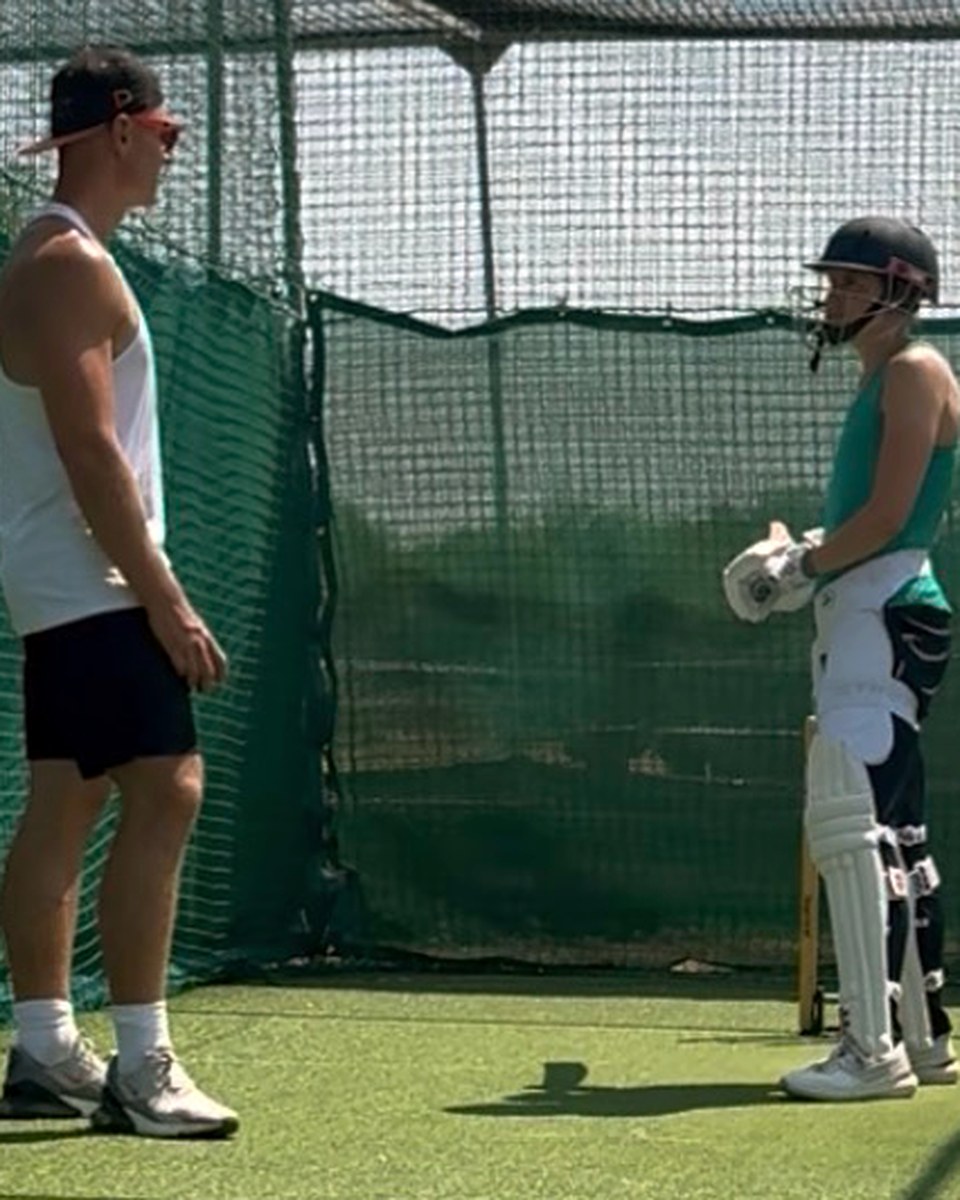
The fix is rarely "just stand your ground". It is kit that fits and protects properly, building up gradually from softer balls and slower pace, and learning the footwork that gets the body in line safely, so getting hit becomes less likely and less of a big deal. Confidence follows competence. One of the clips on our cricket coaching page shows a 1-to-1 session working on exactly this.
What kit do they actually need?
Less than you might think, especially to start.
- First sessions and soft-ball cricket: trainers and comfortable sportswear. That is it.
- Once they move to a hard ball: a properly fitting helmet, batting pads, batting gloves, an abdominal guard and a bat the right size.
Before you spend anything, ask the club whether they have shared junior kit, as many do. And when you do buy a bat, buy for the size they are now, not one to grow into. A bat that is too long or too heavy drags the hands and makes good technique almost impossible. If you are not sure, ask us and we will happily point you in the right direction.
For a sense of the basics we start with, our batting drills for beginners are simple enough to do in the garden together.
How often should kids train?
For most children, one coached session a week plus whatever cricket they play with their club and friends is plenty. More is not better if it starts to feel like a chore. Playing other sports alongside cricket is a good thing too: football, tennis and running all build the athleticism that carries over.
Teenagers pushing for county age-group trials may want more structure, and that is where a proper plan for skill work, strength and rest across the year helps. That is exactly what our Combined Performance programme is built for.
Junior cricket coaching with us
We coach juniors of all abilities, from complete beginners to players pushing for the next level, at Hartley Wintney Cricket Club and the Lucy Pygott Centre nets from March to September, and at the Lucy Pygott Centre over winter. Families come to us from Hartley Wintney, Hook, Fleet and the surrounding villages.
- 1-to-1 coaching from £30 a session in the season for Hartley Wintney CC members (£40 for non-members), with lower rates in blocks of 4 or 10, and £20 a session over winter (October to February).
- Partner coaching (two players, ideally a similar age and level) from £20 a session.
- Group cricket from £10 a session.
If it is your child's first time, our guide to cricket coaching for beginners walks through what actually happens in a first session.
Common questions from parents
What age can my child start cricket coaching?
Most children can start enjoying cricket from around five, with soft balls and simple throwing, catching and hitting games. The ECB's All Stars Cricket programme is built for 5 to 8 year olds and Dynamos Cricket for 8 to 11 year olds. For our own coaching there is no strict minimum age: get in touch and we will tell you honestly whether your child will get something out of it yet.
Should my child join a club or have private coaching?
For most younger beginners, a club junior section or an All Stars or Dynamos programme is a great, affordable first step because of the team-mates and match play. Private coaching works best alongside that, for children who want more than one session a week, need help with something specific such as a technique fault or fear of the ball, or want to keep progressing through the winter.
Does my child have to wear a helmet?
Yes, once they are using a hard ball. ECB guidance says players under 18 must wear a helmet with a faceguard when batting against a hard ball and when keeping wicket up to the stumps, in matches and in practice. Parents can no longer give consent for a young player not to wear one.
How much does junior cricket coaching cost?
With us, 1-to-1 cricket coaching in the season is from £30 a session for Hartley Wintney CC members and £40 for non-members, less in blocks of 4 or 10. Partner coaching for two players is from £20 a session, and group cricket is from £10 a session. Sessions run at Hartley Wintney Cricket Club and the Lucy Pygott Centre from March to September, and at the Lucy Pygott Centre over winter, when 1-to-1 sessions are £20.
Related reading
More from the Training Ground.
Cricket coaching for beginners
No experience, no kit, no idea what to expect. Here is exactly what a first session looks like.
Read moreCricket batting drills for beginners
Stance, grip and three drills that build a proper foundation at the crease, no bowling machine required.
Read more